Direct Anterior Approach (DAA)
Hip Replacement
A modern, tissue-preserving technique that reaches the hip joint through a natural intermuscular plane—eliminating the need to cut major muscle groups. Walk sooner, recover with less discomfort, and regain natural hip mobility.
What is the Direct Anterior Approach (DAA)?
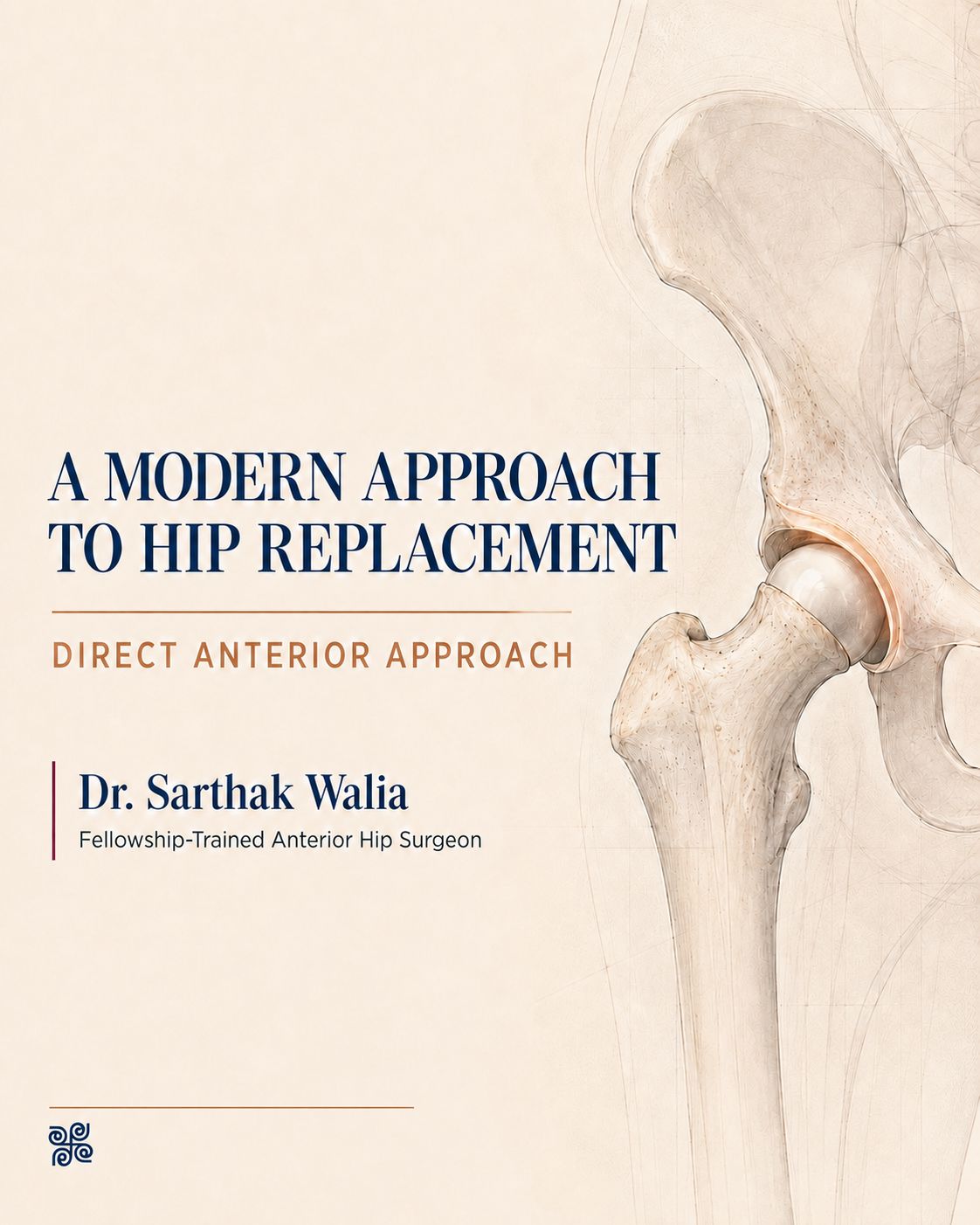
The Direct Anterior Approach (DAA) is an advanced, tissue-sparing surgical technique for Total Hip Arthroplasty (THA). In contrast to conventional posterior or lateral approaches, the surgeon accesses the hip joint from the front of the hip through a natural intermuscular plane (between the tensor fasciae latae and sartorius muscles).
Because this approach gently navigates between muscles rather than detaching or cutting them from the pelvis or femur, major muscles and stabilizers remain completely intact. This muscle-sparing philosophy preserves natural joint dynamics, minimizes tissue trauma, and facilitates substantially faster recovery.
At The Ved Clinic in Dehradun, Dr. Sarthak Walia—a fellowship-trained specialist in joint reconstruction and anterior hip surgery—provides comprehensive clinical assessments to determine whether DAA is the optimal choice for your hip condition.
DAA Clinical Infographics & Patient Guide
Explore our clinical educational series designed by Dr. Sarthak Walia detailing the anatomy, muscle-sparing technique, recovery expectations, and candidacy criteria for DAA hip replacement.
What Makes the Anterior Approach Different?
Traditional hip replacements (posterior or lateral) require the surgeon to cut through or detach substantial muscle tendons—such as the gluteus medius or external rotator muscles—to reach the joint capsule. These detached muscles then require weeks or months to heal after being sutured back.
🌿 Natural Intermuscular Plane
DAA enters through the internervous and intermuscular interval (Hueter interval), gently spreading tissues along natural planes without cutting muscle bellies.
🛡️ Muscle-Sparing Access
Key hip stabilizer muscles remain attached to bone, preserving immediate muscular support, strength, and proprioception directly after surgery.
Potential Early Recovery Benefits
*Clinical evidence demonstrates distinct advantages during early rehabilitation. Individual recovery rates vary based on overall health and physiology.
Earlier Mobilisation
Because hip muscles are not detached, patients frequently stand and walk with assistance on the very same day or Day 1.
Less Discomfort in Early Recovery
Decreased soft tissue surgical trauma leads to lower post-operative pain scores and reduced requirement for heavy analgesics.
Faster Functional Recovery
Quicker independence in climbing stairs, getting in/out of vehicles, and returning to active daily routines.
Who May Be Considered for DAA?
Direct Anterior Approach hip replacement is suited for patients with debilitating hip joint degradation where non-surgical therapies no longer provide adequate pain relief. Common clinical indications include:
🦴 Osteoarthritis
Advanced wear-and-tear of protective cartilage causing severe bone-on-bone groin pain and stiffness.
🩸 Avascular Necrosis (AVN)
Compromised blood supply leading to femoral head collapse, common in younger adults.
🧬 Rheumatoid Arthritis
Chronic systemic autoimmune joint inflammation causing progressive socket erosion.
🩹 Selected Hip Fractures
Acute femoral neck fractures where rapid mobilization is crucial for patient recovery.
The Right Approach for the Right Patient
DAA is not automatically the best choice for everyone. Suitability depends upon rigorous clinical assessment of individual pelvic anatomy, specific diagnosis, severity of bone deformity, prior surgical history, and bone density. Careful clinical evaluation comes first.
Why Specialised Fellowship Training Matters
The Direct Anterior Approach is technically demanding. It requires dedicated sub-specialty fellowship training, mastery of specialized instrumentation, and comprehensive intraoperative planning with an experienced surgical team.
With advanced fellowship credentials in joint replacement and anterior hip surgery, Dr. Sarthak Walia ensures every procedure is executed with meticulous safety boundaries, correct implant positioning, and tailored leg-length restoration.

DAA vs. Traditional Hip Replacement Approaches
| Feature / Metric | Traditional (Posterior/Lateral) | Direct Anterior Approach (DAA) |
|---|---|---|
| Incision & Entry | Back or side of hip (15 - 20 cm) | Front of hip (8 - 10cm) |
| Muscle Treatment | Detaches tendons / splits muscle | 100% Muscle-Sparing (No cutting) |
| First Mobilisation | Day 2 to 3 | Day 1 (Within hours) |
| Early Post-Op Pain | Moderate to high muscular ache | Significantly reduced |
| Post-Op Precautions | Strict 90° bend & crossing ban (6-8 wks) | Minimal / Normal natural motion allowed |
| Dislocation Risk | Higher (posterior capsule opened) | Extremely low (capsule preserved) |
Rehabilitation & Recovery Timeline
Assisted Standing & Walking
Supported standing with a walker under physical supervision. Muscle activation exercises start immediately as soft-tissue integrity is intact.
Home Mobility & Rapid Flexion
Discharge to comfortable home environment. Walking with a single stick or crutch. Comfortable sitting without awkward posture restrictions.
Unassisted Walking & Driving
Most patients safely discontinue walking aids on level ground. Resumption of driving and low-impact desk work as reflex control normalizes.
Full Functional Living
Full return to an active, pain-free lifestyle including brisk walking, cycling, travel, and social recreation.
Frequently Asked Questions about DAA
Dr. Sarthak Walia
Fellowship-Trained Anterior Hip Surgeon
MS (Orthopaedics), Certified in Robotic Arthroplasty & Minimally Invasive Joint Reconstruction.
View Doctor Profile →